The Debrief: Holyrood Insight Additional Support for Learning Conference 2025
Communications Officer Innes Burns debriefs last month’s Holyrood Insight Conference.
The debrief: Holyrood Insight Additional Support for Learning Conference 2025
The Holyrood Insight Additional Support for Learning Conference brought together politicians, educators, parents, academics and campaigners for a frank look at how Scotland supports children and young people with additional support needs. There was a stern yet hopeful tone throughout, with a mix of frustration, realism and genuine appetite to do better. All with a sprinkle of fascinating insight.
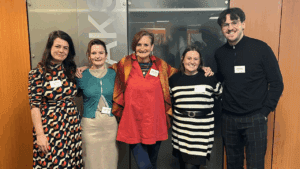
Above: Children in Scotland staff arrive at the Conference. (L-R: Arran Purdie, Jennifer Higgins, Dr Judith Turbyne, Jennifer Drummond, Innes Burns).
Keynote speaker opens the floor
Meghan Gallacher certainly lived up to the billing as keynote speaker. She spoke passionately about the real challenges Scotland faces in meeting the standards we all want for our schools. She also took every question put to her and stayed beyond the scheduled time, a classy and generous showing.
She opened with a clear warning: “Irrespective of background or circumstance, we cannot let children be left behind.” Rising demand, increased complexity and limited resources, she said, define the current landscape. Real change, she reminded us, will not happen overnight, but quick fixes won’t do either.
Gallacher pointed to good practice that already exists but warned of a “system-wide crisis” in ADHD and autism support, with 42,000 children waiting for diagnosis. Teachers, she said, are being left to make assumptions, and “diagnosis is a key, not a label.” She acknowledged that while in theory a diagnosis shouldn’t be needed for support, in practice it often is.
Outdated frameworks, patchy implementation and limited funding were cited as barriers to progress. “Inclusion without investment is impossible,” she said plainly. True inclusion, she argued, can’t be achieved by policy alone. Parents are not obstacles but “experts in their children” who should be part of the process. Her call to action was clear: ASL must be built into all areas of education policy, not treated as an add-on.
Roundtable discussions begin
After a short break, a panel of speakers discussed what inclusion really looks like in schools. Scott McEwan, Head Teacher at Alva Academy, made a strong statement of intent: “I’ll never take an ASN teacher for cover.” His message to the room was direct: He abruptly told the audience: “Decide what you want to do and commit. Go all in.”
Simple, but it really hit home. He asked the audience: what does planning look like? What does the timetable look like? What are your staff doing to achieve that goal?
“You can’t do it half-heartedly,” he said.
Wendy Halliday, Director of See Me Scotland, outlined characteristics of effective inclusion: authentic leadership; building capacity among staff, parents, young people and partners; quality learning and teaching that’s anti-stigma at its core; celebrating diversity; and strong partnerships.
Stella Mouroutsou from the University of Stirling encouraged us to consider the “lenses” we use when seeing children, reminding us that no two children are the same, even when their diagnoses are. A medical lens sees a child as something to be fixed. A social model lens looks for barriers (structural, environmental, attitudinal) that can be removed. And an “embodiment lens” focuses on lived experience and identity. “Even when you have four children on the spectrum,” she said, “they have different needs. We need all these lenses.”
How to make bricks without straw?
That was the title of the talk from Dr Catherine Reid of the University of Glasgow, which quickly grabbed everyone’s attention after lunch. She explored how pressures in the system have built over time, linking current challenges to the erosion of wider support structures since the financial crash and austerity.
Reid spoke about the shift from a deficit model that asks “what’s wrong with you?” to a rights-based model that asks “what do you need to learn?” and urged that the language of crisis is unhelpful: “We’re talking about children, kids who are different.”
She drew attention to persistent gaps highlighted in the 2020 Morgan Report, where parents still have to “battle for scarce resources.” Not every family has the energy or knowledge to do that, she said, and teacher attitudes also make a difference.
Universal design for learning, she argued, benefits everyone. “What works for one will often help others.” She encouraged teachers to see themselves as ASN teachers, regardless of role, and called for more cross-learning between sectors – for example, secondary teachers spending time in early years settings to better understand development and inclusion.
National Parent Forum of Scotland
Cheryl Burnett, a volunteer representing parents across all 32 local authorities, gave an impassioned perspective on the reality families face. So much so, she had me on my feet immediately afterwards, rushing over to shake her hand.
“What’s written in a policy doesn’t always work in a real setting,” she said. Parents, she added, often hit a “brick wall” of frustration, and communication is everything.
She spoke openly about her own experience after chemotherapy, describing how intimidating it can feel to ask for help when you’re already vulnerable. “Not every parent has the confidence to walk into school and do that.”
Her message was simple but powerful: focus on strengths, not deficits. “All I’ve heard is what my kid can’t do. Look for their skills and qualities.” Academic attainment isn’t everything, and small tweaks can make a huge difference.
ADHD Coalition
Bill Colley brought both research and lived experience to his talk on ADHD in classrooms. He described common traits – impulsivity, fidgeting, inattention, emotional regulation challenges – and the social impact these can have. “They’re often seen as annoying or intrusive,” he said, “but they just want friends.”
He noted that Scotland still under-diagnoses ADHD compared to other countries, and pushed back on the myth that parents seek private diagnoses for advantage. He also spoke about how impulsivity can lead to disengagement or risky coping mechanisms later in life, and that many young people simply want more social connection. It was a thought-provoking session for someone that works so closely with young people with ADHD.
Success Looks Different
The day ended on a high with the “Success Looks Different” Awards, celebrating schools that are putting inclusion into action. A huge shoutout to my amazing colleagues at Enquire.
One South Lanarkshire school’s enrichment programme filled gaps in provision and upheld children’s rights, with pupils representing in our National Inclusion Ambassadors and even running their own podcast.
They also created competitive sports events for ASN pupils, inviting neighbouring schools to join, and have achieved five consecutive years of 100 per cent positive destinations for leavers. Alongside strong SQA results, the school has seen sustained improvements in wellbeing and independence skills. A real example of inclusion done right.
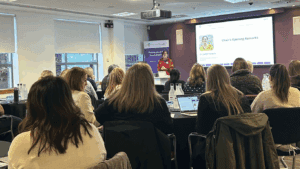
Above: Children in Scotland CEO Dr Judith Turbyne addresses the conference.
“You get it right when you put the child at the centre.”
Across every session, the message was clear. Inclusion can’t be an optional extra. It takes funding, leadership, confident staff and true partnership with parents. As our CEO Judith Turbine summed up in closing: we get the best outcomes when we think about the child in question.

-
 EnquireOne of our core national services, Enquire provides easy to understand advice and information for families and professionals around additional support for learning.Find Out More
 -
ReachEnquire also manages Reach, helping children and young people understand their education rights.Find Out More
-
Resolve (ASL)Resolve Mediation helps assist families to repair and restore damaged relationships and communication.Find Out More
-
My Rights, My SayWe are partners in the My Rights, My Say service, helping children aged 12-15 with additional support needs to be involved in decisions about their education.Find Out More